carel controller manual
Carel Controller Manual: A Comprehensive Guide
This manual details Carel controllers for HVAC/R systems, offering programming, configuration, troubleshooting, and maintenance insights. Explore solutions from Carel Industries S.p.A.
Carel controllers represent a sophisticated approach to managing HVAC and refrigeration systems, offering programmable logic for precise environmental control. These devices, sourced from Carel Industries S.p.A., are designed for optimal performance and energy efficiency. They integrate seamlessly into diverse applications, from simple unit control to complex system monitoring.
c•link programming software empowers users to customize controller functions, while robust communication protocols like Modbus and BACnet ensure interoperability. Understanding these controllers is crucial for technicians and engineers seeking reliable and adaptable solutions.

Understanding Carel Controller Applications
Carel controllers excel in a wide spectrum of applications, notably HVAC and refrigeration systems, providing precise temperature and humidity regulation. They are utilized in supermarkets, cold storage facilities, and commercial buildings, optimizing energy consumption and maintaining product integrity.
These programmable controllers also support system solutions, enabling complex control strategies and remote monitoring. Their adaptability makes them ideal for both new installations and retrofitting existing systems, enhancing overall operational efficiency and reliability.
Controller Series Overview (pRO-3, pRO-5, etc.)
Carel offers diverse controller series like pRO-3 and pRO-5, each tailored for specific application complexities. pRO-3 controllers are suited for simpler refrigeration and HVAC tasks, while pRO-5 provides advanced features for demanding systems.
Further options include unit terminals and monitoring tools, expanding control capabilities. These series vary in processing power, I/O capacity, and communication protocols, allowing users to select the optimal controller for their needs, ensuring efficient and reliable system operation.
Hardware Components and Specifications
Carel controllers comprise a central processing unit, I/O modules, and optional communication interfaces. Robust construction ensures reliability in industrial environments. Specifications vary by series, detailing processing speed, memory capacity, and operating temperature ranges.
Key components include microprocessors and flash memory. Controllers support diverse input types (analog, digital) and output control (relays, triacs). Detailed datasheets provide precise specifications for each model, aiding in proper system integration and component selection.
Power Supply Requirements
Carel controllers typically operate on 24VAC or 24VDC power sources, though specific requirements depend on the model. Ensure the power supply provides stable, regulated voltage within the specified tolerance to prevent malfunctions or damage.
Consider power consumption when sizing the power supply, accounting for all connected I/O modules. Proper grounding is crucial for safety and noise immunity. Refer to the controller’s datasheet for precise voltage, current, and polarity specifications before installation.
Input/Output (I/O) Modules
Carel controllers utilize various I/O modules for interfacing with field devices like sensors, actuators, and alarms. These modules expand the controller’s capabilities, supporting digital inputs, digital outputs, analog inputs, and analog outputs.
Module selection depends on the application’s needs; consider signal type, range, and isolation requirements. Proper wiring and termination are essential for reliable operation. Refer to the controller’s documentation for compatibility and configuration details of each I/O module.
Software and Programming
Carel controllers are programmed using dedicated software, primarily c•link, offering a user-friendly interface for configuration and logic development. This software facilitates creating custom control strategies tailored to specific HVAC/R applications.
Programming involves defining system parameters, input/output mappings, and control algorithms. Carel provides extensive documentation and examples to assist programmers. Understanding the controller’s capabilities and the application’s requirements is crucial for effective programming.
Carel c•link Programming Software
c•link is Carel’s integrated programming environment, designed for configuring and monitoring their range of controllers. It provides a graphical interface for creating application programs, utilizing function blocks and ladder logic.
The software supports online monitoring, allowing real-time visualization of system variables and diagnostics. c•link simplifies commissioning, troubleshooting, and maintenance, offering a comprehensive toolset for managing Carel controllers effectively. Regular updates enhance functionality and compatibility.
Programming Languages and Logic
Carel controllers support multiple programming languages, including ladder logic (LD), function block diagram (FBD), and structured text (ST). LD is ideal for relay-based control, while FBD excels in complex algorithms. ST offers powerful text-based programming capabilities.
Logic implementation utilizes function blocks representing specific control functions, simplifying program development and reusability. These blocks handle tasks like temperature control, defrost cycles, and fan management, streamlining the creation of sophisticated HVAC/R applications.
Basic Controller Configuration
Initial controller setup involves defining essential system parameters, including temperature units (Celsius or Fahrenheit) and time settings. Accurate configuration is crucial for optimal performance and reliable operation of the HVAC/R system.
Defining input and output (I/O) points maps physical sensors and actuators to controller variables. This process establishes communication between the controller and the controlled environment, enabling precise monitoring and control of critical parameters.
Setting System Parameters
System parameters define the operational characteristics of the Carel controller. Key settings include temperature scales (Celsius or Fahrenheit), date and time formats, and language preferences for the user interface.
Advanced parameters encompass alarm thresholds, control algorithms, and communication settings. Proper configuration ensures the controller functions correctly within the specific application, optimizing system efficiency and responsiveness. Careful attention to detail is essential during this stage.
Defining Input and Output Points
Precisely defining input and output (I/O) points is crucial for accurate controller operation. Inputs represent sensors (temperature, pressure, humidity) feeding data to the controller, while outputs control actuators (valves, fans, compressors).
Each I/O point requires a unique address and descriptive label. Correct mapping ensures the controller interprets signals correctly and executes commands as intended, forming the foundation of automated control strategies.
Refrigeration Control Functions
Carel controllers excel in refrigeration management, offering precise temperature control and efficient operation. Key functions include maintaining setpoints, managing evaporator and condenser fans, and optimizing compressor cycles for energy savings.
Advanced algorithms adapt to varying loads and ambient conditions. These controllers support diverse refrigeration systems, ensuring optimal performance and reliability, as highlighted by Carel’s comprehensive solutions for HVAC/R applications.
Temperature Control Algorithms
Carel controllers utilize sophisticated algorithms—like PID (Proportional-Integral-Derivative)—for precise temperature regulation in refrigeration systems. These algorithms minimize overshoot and oscillation, maintaining stable temperatures even with fluctuating loads.
Adaptive tuning automatically optimizes control parameters, ensuring efficient performance across diverse applications. Controllers support various sensor types and offer customizable settings to meet specific refrigeration needs, enhancing overall system reliability and energy efficiency.
Defrost Management
Carel controllers offer advanced defrost management strategies to prevent ice buildup on evaporator coils, crucial for refrigeration efficiency. Options include electric, hot gas, and air defrost cycles, selectable based on application requirements.
Intelligent defrost algorithms minimize energy consumption by initiating defrost only when necessary, based on frost sensor data or time intervals. Customizable parameters allow fine-tuning for optimal defrost performance and reduced operational costs, ensuring consistent cooling capacity.
HVAC Control Functions
Carel controllers provide comprehensive HVAC control, managing diverse applications with precision. They support various functions like heating, cooling, ventilation, and humidity control, optimizing indoor climate conditions.
Advanced algorithms enable efficient fan control strategies, adapting to load demands and minimizing energy usage. Controllers integrate seamlessly with HVAC systems, offering robust performance and reliable operation for commercial and industrial buildings, ensuring comfort and efficiency.
Fan Control Strategies
Carel controllers employ sophisticated fan control strategies for optimal HVAC system performance. These include fixed speed, proportional, and variable frequency drive (VFD) control, adapting to diverse system requirements.
Algorithms dynamically adjust fan speed based on demand, maximizing energy efficiency and maintaining desired temperature and airflow. Controllers support multiple fan stages and offer advanced features like economizer control, enhancing overall system effectiveness and reducing operational costs.
Humidity Control Options
Carel controllers provide versatile humidity control options for precise environmental management. Strategies include proportional humidity control, utilizing modulating humidifiers or dehumidifiers to maintain setpoints efficiently.
Controllers support various sensor inputs and offer advanced algorithms for optimized performance, preventing condensation and ensuring occupant comfort. Integration with dehumidification systems and steam humidifiers is seamless, offering comprehensive humidity management within HVAC/R applications.
Communication Protocols
Carel controllers support multiple communication protocols for seamless system integration. Key options include Modbus, enabling communication with various building automation systems and third-party devices.
BACnet integration allows for comprehensive network connectivity and centralized control. These protocols facilitate data exchange for monitoring, control, and diagnostics, enhancing overall system efficiency and providing remote access capabilities. Utilizing these protocols ensures compatibility and streamlined management of complex HVAC/R installations.

Modbus Communication
Modbus is a widely adopted protocol for connecting Carel controllers to Building Management Systems (BMS). It supports both Modbus RTU (serial) and Modbus TCP (Ethernet) for flexible network configurations.
Configuration involves defining Modbus registers for reading controller data (temperatures, statuses) and writing control commands. Proper addressing and data mapping are crucial for successful communication. This allows for centralized monitoring and control of refrigeration and HVAC systems, enhancing operational efficiency.
BACnet Integration
BACnet (Building Automation and Control Networks) provides advanced interoperability for Carel controllers. It enables seamless communication with other BACnet-compliant devices within a building automation system, facilitating centralized control and monitoring.
Configuration involves defining BACnet objects and properties, allowing the BMS to access controller data and manipulate settings. This integration streamlines system management, improves energy efficiency, and supports advanced building automation strategies.
Troubleshooting Common Issues
Effective troubleshooting requires understanding error codes and utilizing diagnostic tools within the Carel controller. Common problems include communication failures, sensor inaccuracies, and incorrect parameter settings.
Remote access and monitoring capabilities, when configured, allow for proactive identification and resolution of issues. Regularly checking system logs and utilizing the c•link software’s diagnostic features are crucial for maintaining optimal performance and minimizing downtime.
Error Codes and Diagnostics
Carel controllers utilize a comprehensive system of error codes to pinpoint malfunctions. These codes, detailed in the controller’s documentation, indicate issues ranging from sensor failures to communication errors.
Diagnostic features within the c•link software allow technicians to interpret these codes, view real-time data, and perform tests to isolate the root cause. Understanding these tools is vital for efficient troubleshooting and minimizing system downtime, ensuring reliable operation.
Remote Access and Monitoring
Carel controllers, when integrated with appropriate network infrastructure, support remote access and monitoring capabilities. Utilizing protocols like Modbus and BACnet, technicians can oversee system performance and diagnose issues from offsite locations.
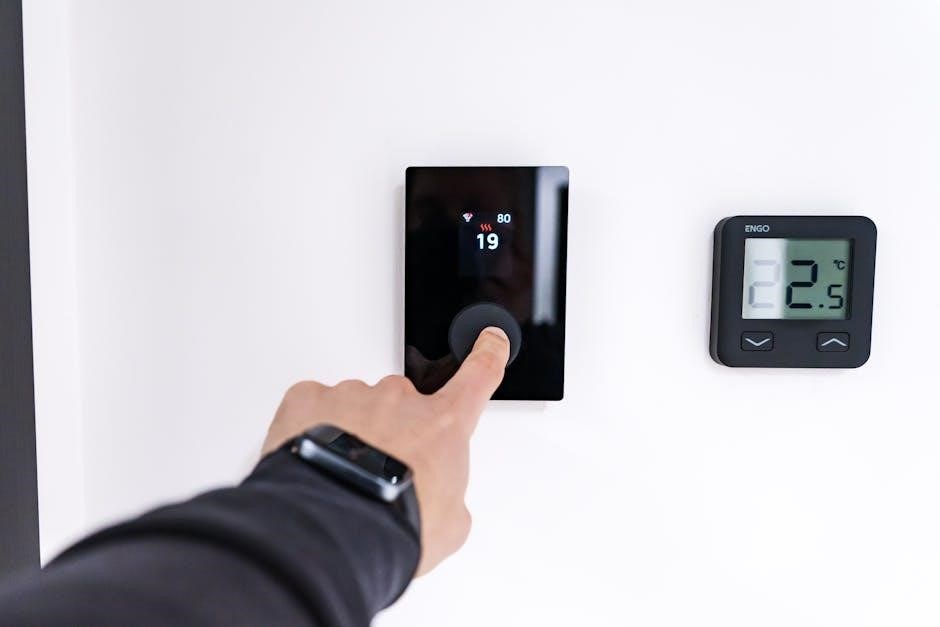
This functionality minimizes on-site visits, enabling proactive maintenance and faster response times. c•link software often provides secure remote connections, enhancing operational efficiency and reducing overall maintenance costs for complex HVAC/R systems.
Controller Maintenance and Updates
Regular maintenance ensures optimal Carel controller performance and longevity. This includes periodic hardware inspections for dust accumulation and connection integrity. Crucially, firmware updates are vital for accessing the latest features, security patches, and bug fixes.
Carel provides updates through its website and c•link software. Following update procedures carefully prevents system instability. Proper maintenance, combined with timely updates, maximizes system reliability and minimizes downtime.
Firmware Updates
Carel provides firmware updates via its official website and the c•link programming software, enhancing controller functionality and security. Before updating, always back up the current controller configuration to prevent data loss during the process.
Carefully follow the provided instructions to avoid interrupting the update, which could render the controller inoperable. Successful updates deliver bug fixes, new features, and improved system performance, ensuring optimal operation.
Hardware Inspection
Regular hardware inspection is crucial for maintaining controller reliability. Visually check for any signs of physical damage, such as loose connections, corrosion, or burnt components. Ensure proper ventilation to prevent overheating, and verify that all cables are securely fastened.
Inspect I/O modules for damage and confirm correct wiring. A proactive approach to hardware maintenance minimizes downtime and extends the controller’s lifespan, ensuring consistent performance.
Safety Precautions and Guidelines
Always disconnect power before performing any maintenance or inspection. Qualified personnel should handle controller installations and modifications, adhering to local electrical codes. Avoid contact with live circuits and utilize appropriate personal protective equipment (PPE), including insulated tools.
Never attempt repairs beyond your expertise; improper handling can cause damage or injury. Follow Carel’s guidelines for safe operation and ensure proper grounding to prevent electrical hazards.

Resources and Support
For comprehensive documentation and software downloads, visit the official Carel website (https://www.carel.com). Explore their extensive library of manuals, application notes, and technical specifications. Connect with Carel via social media – Facebook, LinkedIn, X, and YouTube – for updates and community forums.
Direct technical support is available through Carel Industries S.p.A.; contact information can be found on their website for assistance with specific controller issues.
Carel Website and Documentation
The Carel website (https://www.carel.com) serves as the primary hub for all controller-related resources. Access detailed product manuals, datasheets, and application guides. Download the latest c•link programming software and firmware updates. Explore a wealth of technical information, including wiring diagrams and troubleshooting tips.
Subscribe to their newsletter for updates and new product announcements. The site offers comprehensive support for all Carel controller series.
Technical Support Contact Information
For direct technical assistance with Carel controllers, visit the Carel website’s “Contact Us” section. While specific contact details aren’t directly provided in the source, the website facilitates inquiries regarding their programmable controls and HVAC/R solutions.
Explore their online documentation and FAQs first. For complex issues, utilize the website’s form to connect with a Carel support specialist. Carel Industries S.p.A. is based in Padova, Italy.